
Growth Marketing is a data-driven marketing approach focused on achieving sustainable business growth. Instead of concentrating only on attracting new customers, Growth Marketing looks at the entire customer journey—from awareness and acquisition to activation, retention, referrals, and revenue.
The goal is to continuously test different strategies, measure results, and improve marketing activities based on real customer behavior.
What Is Growth Marketing?
Growth Marketing is a process of using data, experimentation, creativity, and customer insights to find effective ways to grow a business.
Traditional marketing may focus heavily on campaigns and short-term promotions. Growth Marketing takes a broader approach by asking questions such as:
- How can we attract more potential customers?
- How can we turn visitors into customers?
- Why do customers leave?
- How can we increase customer retention?
- How can satisfied customers recommend the business to others?
This makes Growth Marketing useful for startups, online businesses, e-commerce companies, SaaS businesses, and established organizations.
Why Is Growth Marketing Important?
Growth Marketing helps businesses make marketing decisions based on evidence rather than assumptions.
Key benefits include:
- Improves customer acquisition: Helps businesses find more effective ways to attract customers.
- Increases retention: Focuses on keeping existing customers engaged.
- Supports experimentation: Allows businesses to test different ideas before investing heavily.
- Improves marketing efficiency: Helps identify which channels and campaigns produce the best results.
- Encourages sustainable growth: Focuses on long-term improvements rather than short-term results.
Key Elements of Growth Marketing
1. Customer Acquisition
Acquisition is about attracting new customers through channels such as search engines, social media, email marketing, paid advertising, content marketing, and referrals.
Growth marketers analyze each channel to determine which ones bring valuable customers.
2. Customer Activation
Getting someone to visit a website or download an app is not enough. Activation focuses on helping new users experience the value of a product or service quickly.
For example, a software company might guide a new user through setting up an account and using an important feature.
3. Customer Retention
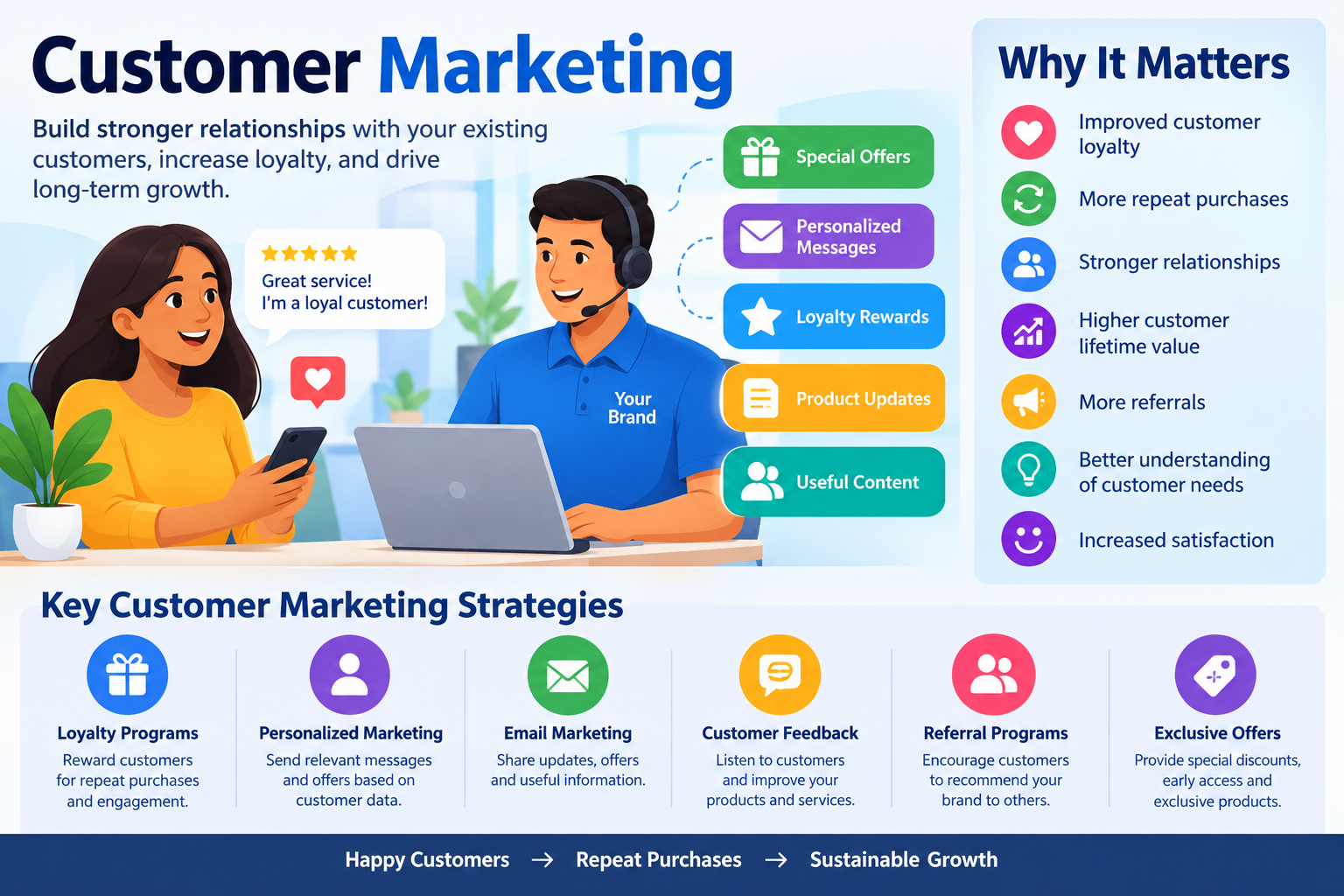
Retention focuses on keeping customers over time. Businesses can improve retention through excellent customer service, useful content, personalized communication, product improvements, and loyalty programs.
4. Referrals
Satisfied customers can become an important source of new business. Referral programs can encourage customers to recommend a product or service to friends, colleagues, and family.
5. Revenue Growth
Growth Marketing ultimately aims to improve business revenue. This can involve increasing sales, improving conversion rates, reducing customer acquisition costs, or increasing customer lifetime value.
Growth Marketing Strategies
Businesses can use several strategies to support growth.
A/B Testing: Compare two versions of a webpage, advertisement, email, or landing page to see which performs better.
Content Marketing: Create useful content that attracts potential customers and builds trust.
Email Marketing: Use targeted emails to educate customers, promote products, and encourage repeat purchases.
SEO: Improve website visibility in search engines to attract relevant organic traffic.
Social Media Marketing: Use social platforms to build awareness, engage customers, and generate leads.
Referral Marketing: Encourage existing customers to recommend the business to others.
Conversion Rate Optimization: Improve websites and landing pages to turn more visitors into customers.
Growth Marketing vs. Traditional Marketing
Traditional marketing often focuses on creating campaigns that reach a target audience. Growth Marketing takes a more continuous and experimental approach.
A traditional marketer might launch an advertising campaign and evaluate its results afterward. A growth marketer may continuously test different audiences, messages, landing pages, offers, and channels to identify opportunities for improvement.
The two approaches are not competitors. Traditional marketing techniques can be part of a broader Growth Marketing strategy.
How to Create a Growth Marketing Strategy
A simple Growth Marketing strategy can follow these steps:
- Define clear growth goals.
- Understand your target customers.
- Map the customer journey.
- Identify opportunities for improvement.
- Choose measurable marketing channels.
- Create experiments and tests.
- Measure the results.
- Keep what works and improve what does not.
- Repeat the process continuously.
Measuring Growth Marketing Success
Growth Marketing depends heavily on measurable results. Important metrics include:
- Customer acquisition cost (CAC)
- Customer lifetime value (CLV)
- Conversion rate
- Customer retention rate
- Churn rate
- Website traffic
- Lead generation
- Revenue
- Return on marketing investment (ROMI)
Tracking these metrics helps businesses understand where growth is coming from and where improvements are needed.
Conclusion
Growth Marketing is a powerful approach for businesses that want to achieve sustainable growth through continuous testing, data analysis, and customer-focused strategies. It considers the entire customer journey rather than focusing only on attracting new customers.
By testing ideas, measuring performance, improving customer experiences, and investing in strategies that produce results, businesses can build a more efficient and scalable marketing system.