Account-Based Marketing (ABM): A Complete Guide for Businesses
What Is Account-Based Marketing (ABM)?
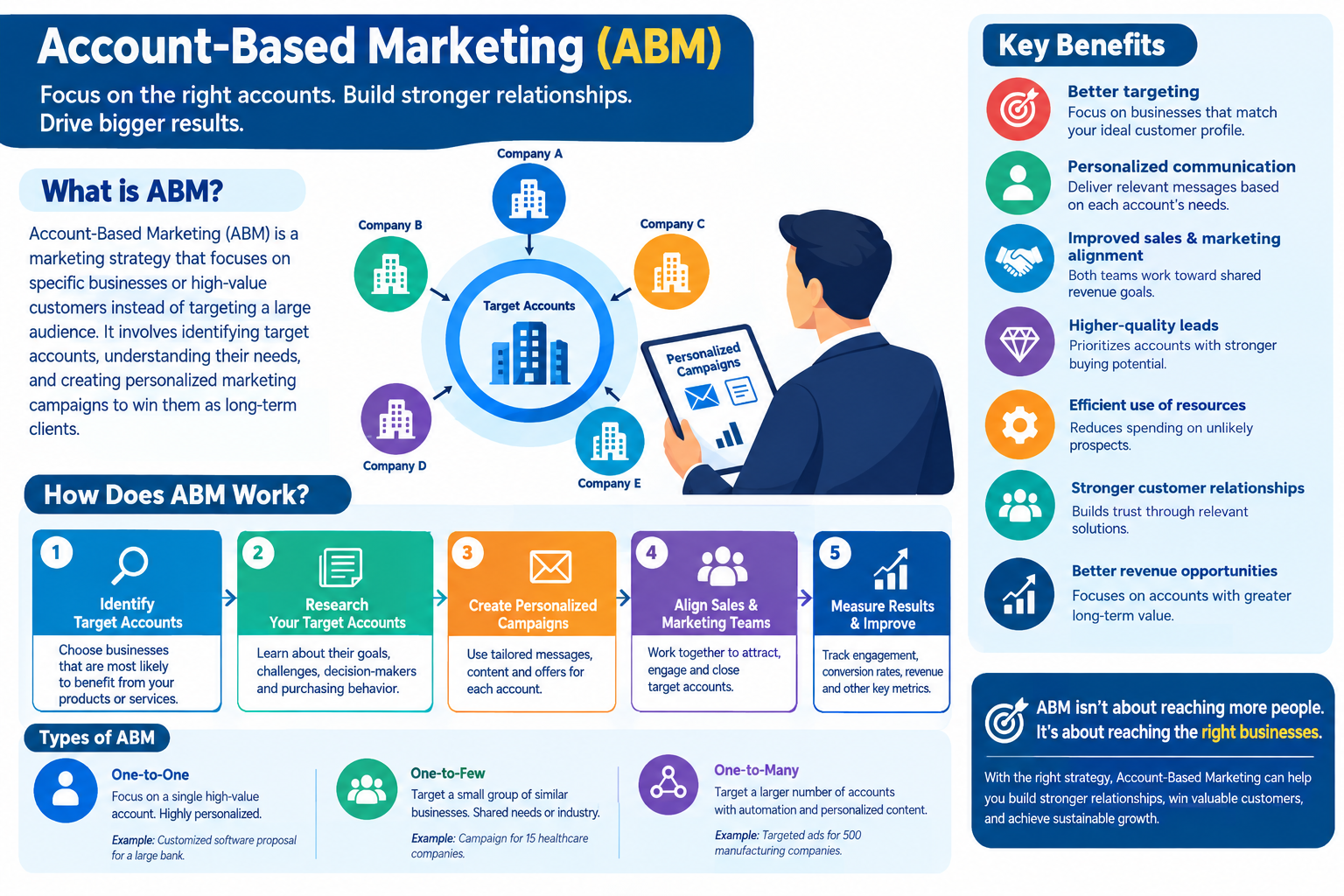
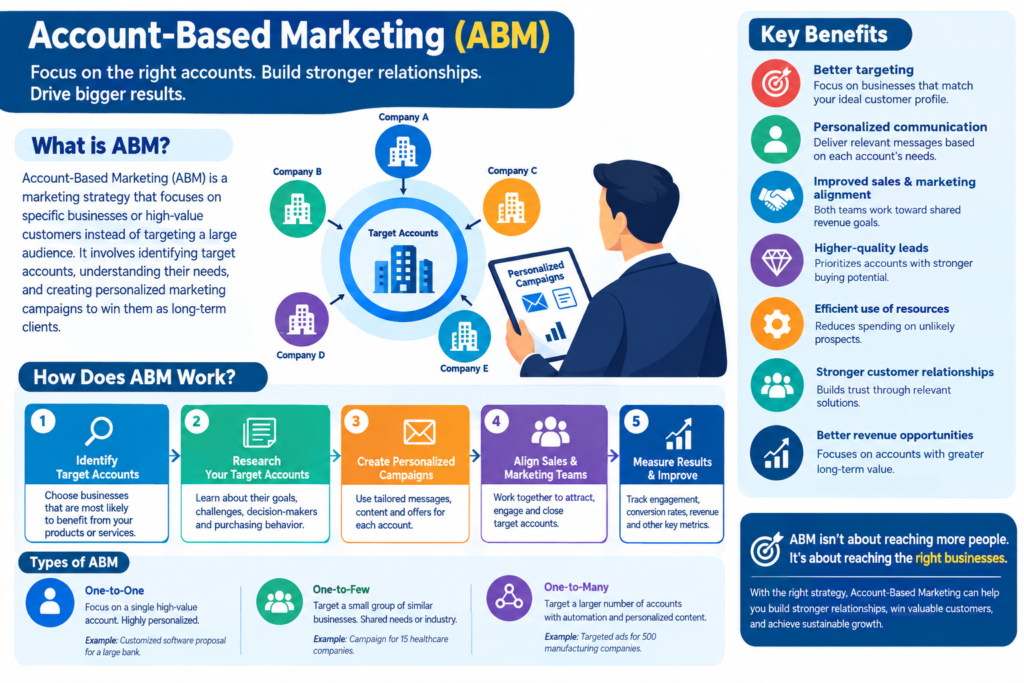
Account-Based Marketing (ABM) is a marketing strategy that focuses on specific businesses or high-value customers instead of targeting a large audience. It involves identifying potential customers, understanding their needs, and creating personalized marketing campaigns to attract and convert them into long-term clients.
Account-Based Marketing is commonly used by business-to-business (B2B) companies that sell products or services to other businesses. For example, a software company may target 20 large companies and develop a unique marketing strategy for each one.
Rather than reaching thousands of people with the same message, ABM helps businesses focus their time and resources on the customers most likely to generate significant revenue.
How Does Account-Based Marketing Work?
Account-Based Marketing follows a structured process that helps businesses connect with their ideal customers.
1. Identify Target Accounts
The first step is to select businesses that are most likely to benefit from your products or services. Companies can consider factors such as industry, company size, budget, location, and business needs.
2. Research Your Target Accounts
After identifying potential customers, research their goals, challenges, decision-makers, and purchasing behavior. This information helps you understand how your product or service can solve their problems.
3. Create Personalized Marketing Campaigns
Develop marketing messages and content that address the specific needs of each target account. These may include personalized emails, case studies, product demonstrations, advertisements, and customized proposals.
4. Align Sales and Marketing Teams
Account-Based Marketing works best when sales and marketing teams collaborate. Marketing attracts and engages target accounts, while sales representatives build relationships and guide potential customers through the buying process.
5. Measure Results and Improve
Track campaign performance using metrics such as account engagement, qualified opportunities, conversion rates, customer acquisition costs, and revenue generated.
Types of Account-Based Marketing
There are three common approaches to Account-Based Marketing.
1. One-to-One ABM
This approach focuses on a small number of high-value accounts. Each account receives a highly personalized marketing strategy based on its specific challenges and business goals.
Example: A technology company develops a customized software proposal for a large bank.
2. One-to-Few ABM
This approach targets a small group of similar businesses. Companies in the group may share the same industry, challenges, or needs.
Example: A cybersecurity provider creates a campaign targeting 15 healthcare companies.
3. One-to-Many ABM
This approach targets a larger number of accounts using marketing automation, customer data, and personalized content. Although the campaigns are more scalable, they still focus on specific target accounts.
Example: A business software company runs targeted advertising campaigns for 500 medium-sized manufacturing companies.
Benefits of Account-Based Marketing
Account-Based Marketing offers several advantages for businesses.
- Better targeting: Focuses marketing efforts on businesses that match your ideal customer profile.
- Personalized communication: Delivers relevant messages based on each account’s needs.
- Improved sales and marketing alignment: Encourages both teams to work toward shared revenue goals.
- Higher-quality leads: Prioritizes accounts that have a stronger potential to become customers.
- Efficient use of resources: Reduces spending on audiences that are unlikely to purchase.
- Stronger customer relationships: Builds trust through relevant communication and tailored solutions.
- Better revenue opportunities: Helps businesses concentrate on accounts that may offer greater long-term value.
Account-Based Marketing vs. Traditional Marketing
Traditional marketing often targets a broad audience to generate as many leads as possible. Account-Based Marketing focuses on a selected group of businesses that fit specific criteria.
| Feature | Account-Based Marketing | Traditional Marketing |
|---|---|---|
| Target audience | Selected business accounts | Broad audience |
| Personalization | Highly personalized | Often general |
| Main goal | Win valuable target accounts | Generate awareness and leads |
| Sales and marketing | Closely aligned | May operate separately |
| Success measurement | Account engagement and revenue | Reach, leads, and conversions |
| Best suited for | Many B2B sales strategies | B2B and B2C marketing |
Both approaches can be effective. The right choice depends on your business goals, audience, budget, and sales process.
Account-Based Marketing Strategies
Businesses can improve their ABM campaigns by using the following strategies.
Define Your Ideal Customer Profile
Identify the characteristics of businesses that are most likely to become profitable customers. Consider industry, company size, budget, location, and purchasing needs.
Use Personalized Email Marketing
Send relevant emails to decision-makers within your target accounts. Address their business challenges and explain how your solution can help.
Create Valuable Content
Develop case studies, industry reports, guides, and presentations that answer the questions your target accounts are likely to have.
Use LinkedIn and Targeted Advertising
Professional networking platforms and account-targeted advertising can help businesses reach relevant decision-makers and maintain visibility throughout the buying process.
Build Relationships With Decision-Makers
Connect with the people involved in purchasing decisions, such as managers, department heads, and executives. Understanding their priorities helps you present more relevant solutions.
Use Marketing Automation and CRM Tools
Customer relationship management (CRM) and marketing automation tools can help organize account information, track engagement, manage follow-ups, and coordinate sales and marketing activities.
Common Account-Based Marketing Challenges
Although ABM offers many benefits, businesses may face several challenges when implementing it.
- Limited account data: Incomplete information makes it difficult to understand target customers.
- Time and resource requirements: Personalized campaigns require research, planning, and coordination.
- Sales and marketing misalignment: Different goals can reduce campaign effectiveness.
- Measuring performance: Revenue and account engagement may take time to develop.
- Personalization at scale: Creating relevant campaigns for many accounts can be challenging.
Businesses can address these problems by setting clear goals, maintaining accurate customer data, sharing information between teams, and using suitable marketing technology.
How to Measure Account-Based Marketing Success
Measuring performance helps businesses understand whether their ABM campaigns are achieving their goals.
Important metrics include:
- Account engagement: How frequently target accounts interact with your marketing content.
- Conversion rate: The percentage of engaged or qualified accounts that become customers.
- Pipeline value: The potential sales revenue associated with target accounts.
- Customer acquisition cost (CAC): The cost of acquiring a new customer.
- Return on investment (ROI): The financial return generated compared with the campaign’s cost.
- Deal size: The average revenue generated from successful deals.
- Sales cycle length: The time required to convert a target account into a customer.
Businesses should evaluate these metrics over time rather than relying on a single campaign result.
Examples of Account-Based Marketing
Consider a company that sells business management software.
Instead of advertising to every business, the company identifies 30 large companies that need better operational systems. It researches each company’s challenges, sends personalized emails to relevant managers, shares industry-specific case studies, and offers tailored product demonstrations.
The sales team then follows up with interested accounts and develops customized proposals.
This is Account-Based Marketing in practice: focusing on specific businesses, providing relevant solutions, and building relationships that can lead to valuable sales.
Conclusion
Account-Based Marketing (ABM) is an effective strategy for businesses that want to focus on high-value customers, personalize their marketing efforts, and improve collaboration between sales and marketing teams.
By identifying the right accounts, researching their needs, creating targeted campaigns, and measuring performance, businesses can build stronger relationships and improve their chances of winning valuable customers.
For B2B companies with longer sales cycles or complex purchasing decisions, Account-Based Marketing can be a valuable part of a long-term growth strategy.