
B2B Marketing: A Complete Guide for Businesses
B2B Marketing (Business-to-Business Marketing) is the process of promoting products or services from one business to another. Unlike B2C marketing, which targets individual consumers, B2B Marketing focuses on companies, organizations, and professional decision-makers.
B2B Marketing is important for businesses that sell software, equipment, consulting services, technology, professional services, wholesale products, and other business solutions.
What Is B2B Marketing?
B2B Marketing involves strategies designed to attract businesses, generate leads, build professional relationships, and convert potential companies into customers.
For example, a software company selling accounting software to other companies is using B2B Marketing. Similarly, a manufacturer selling equipment to retailers is operating in a B2B market.
Why Is B2B Marketing Important?
B2B Marketing helps companies reach the right business customers and communicate the value of their products or services. A well-planned strategy can help businesses:
- Generate qualified leads
- Increase brand awareness
- Build long-term business relationships
- Improve customer acquisition
- Increase sales opportunities
- Establish industry authority
- Retain existing business customers
Common B2B Marketing Strategies
1. Content Marketing
Businesses can create useful content such as blog posts, reports, case studies, guides, and videos. High-quality content can help potential customers understand a problem and discover possible solutions.
2. Search Engine Optimization
SEO helps businesses appear in search engine results when potential customers search for relevant products or services. B2B companies can target keywords related to their industry, products, and customer problems.
3. Email Marketing
Email marketing allows businesses to communicate directly with potential and existing customers. Companies can use emails to share product information, industry insights, special offers, and company updates.
4. Social Media Marketing
B2B companies can use platforms such as LinkedIn, Facebook, and other professional or social networks to share useful information, connect with decision-makers, and build brand awareness.
5. Paid Advertising
Businesses can use search advertising, display advertising, and social media advertising to reach specific professional audiences. Targeting can help companies focus their advertising budget on relevant industries and decision-makers.
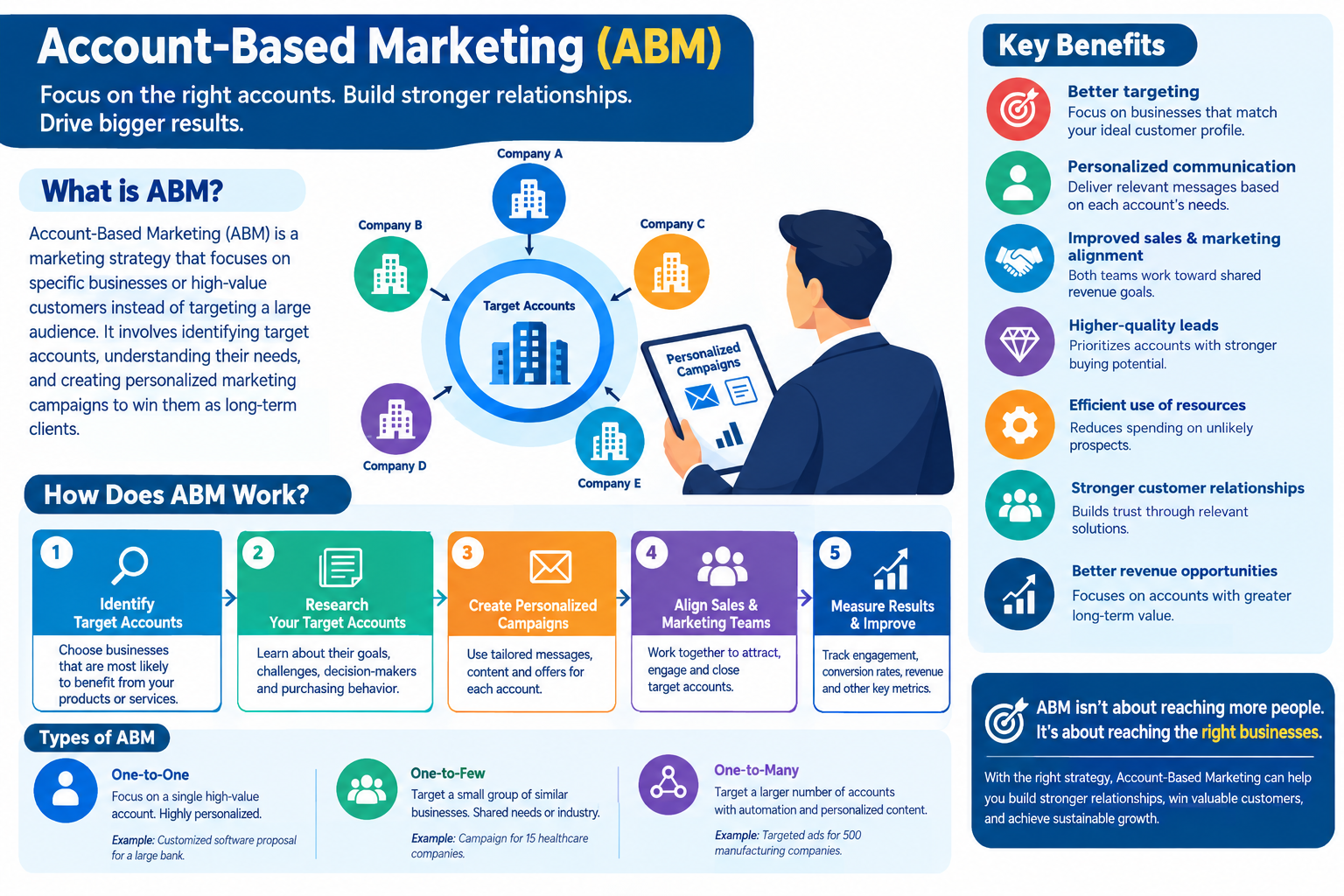
6. Account-Based Marketing
Account-Based Marketing (ABM) focuses on specific high-value companies or accounts. Instead of targeting a large general audience, marketing and sales teams work together to create campaigns for selected businesses.
B2B Marketing vs. B2C Marketing
The main difference is the target audience.
| B2B Marketing | B2C Marketing |
|---|---|
| Targets businesses | Targets individual consumers |
| Often involves multiple decision-makers | Often involves fewer decision-makers |
| Purchasing decisions may take longer | Purchases can often happen faster |
| Focuses strongly on business value and ROI | Often focuses on benefits, convenience, and personal needs |
| Relationships can be long-term | Relationships vary depending on the product |
How to Create a B2B Marketing Strategy
A successful B2B Marketing strategy should begin with a clear understanding of the target business customer.
Step 1: Identify Your Target Market
Determine which industries, company sizes, locations, and types of businesses are most likely to need your product or service.
Step 2: Understand Customer Needs
Research the problems your target businesses face. Understanding these problems helps you create marketing messages that are relevant and useful.
Step 3: Choose the Right Marketing Channels
Select channels based on where your target customers spend time and how they research business solutions. These may include search engines, email, social media, industry websites, and business events.
Step 4: Create Valuable Content
Develop content that answers customer questions and demonstrates your expertise. Examples include tutorials, industry reports, comparison articles, case studies, and product guides.
Step 5: Measure Performance
Track metrics such as website traffic, leads, conversion rates, cost per lead, customer acquisition cost, and sales revenue. These measurements can help businesses understand which marketing activities are producing results.
Benefits of B2B Marketing
B2B Marketing can provide several benefits when it is properly planned and managed. It can help businesses reach specialized audiences, generate qualified leads, develop professional relationships, and create a consistent sales pipeline.
It can also help companies establish credibility by demonstrating their knowledge and experience within a particular industry.
Challenges of B2B Marketing
B2B Marketing can also present challenges. Business purchasing decisions may involve multiple people, longer sales cycles, detailed product evaluations, and larger budgets.
Companies may need to coordinate marketing and sales teams closely to ensure that potential customers receive accurate and consistent information throughout the buying process.
Conclusion
B2B Marketing is an important approach for businesses that sell products or services to other businesses. By understanding the target market, creating valuable content, using appropriate marketing channels, and measuring results, companies can build stronger relationships and create more opportunities for growth.
A successful B2B Marketing strategy focuses not only on selling a product but also on understanding business customers and providing solutions to their specific needs.