
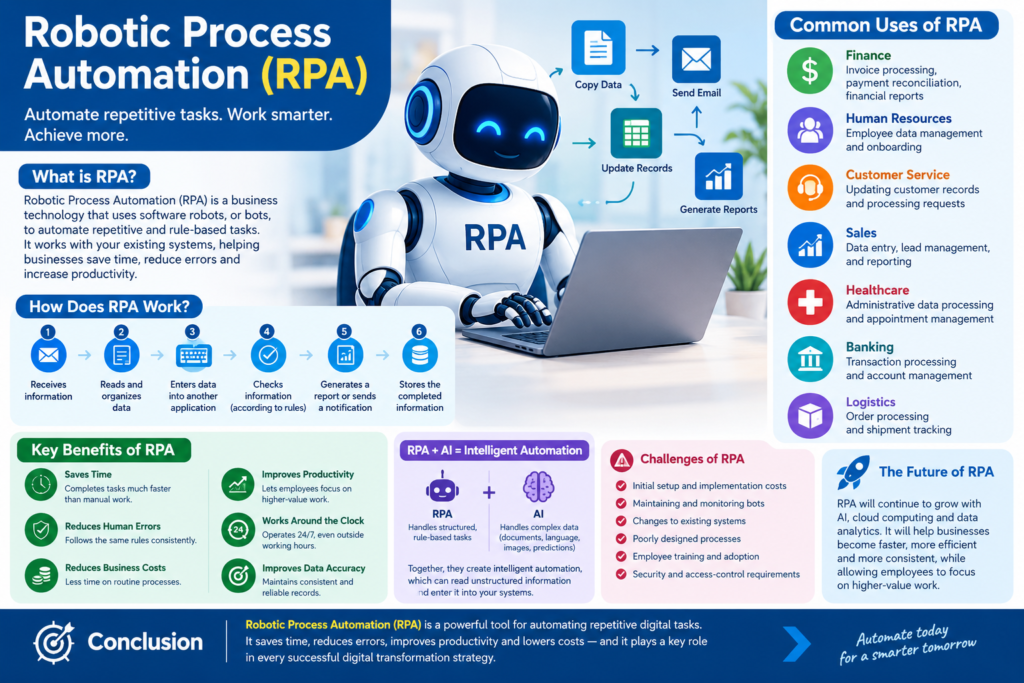
Robotic Process Automation (RPA): A Simple Guide for Modern Businesses
Robotic Process Automation (RPA) is a business technology that uses software robots, often called bots, to automate repetitive and rule-based tasks. Instead of employees spending hours entering data, copying information, checking records, or creating reports, RPA bots can perform these tasks automatically and consistently.
What Is Robotic Process Automation (RPA)?
Robotic Process Automation (RPA) allows businesses to create software bots that interact with computer applications in much the same way a person does. These bots can open applications, enter information, move data between systems, send emails, generate reports, and perform other repetitive activities.
RPA does not necessarily replace existing software. Instead, it can work with the systems a business already uses, making processes faster and more efficient.
How Does RPA Work?
RPA follows predefined rules and instructions. A typical automated process may work like this:
- The bot receives information from an email or business system.
- It reads and organizes the information.
- The bot enters the data into another application.
- It checks the information according to predefined rules.
- It generates a report or sends a notification.
- The completed information is stored for future use.
Because these steps are automated, employees can spend more time on tasks that require human judgment and communication.
Benefits of Robotic Process Automation (RPA)
1. Saves Time
RPA can complete repetitive tasks much faster than manual processing.
2. Reduces Human Errors
Bots follow the same instructions consistently, reducing common data-entry and calculation mistakes.
3. Reduces Business Costs
Automating repetitive work can reduce the amount of time employees spend on routine processes.
4. Improves Productivity
Employees can focus on customer service, problem-solving, planning, and other valuable activities.
5. Works Around the Clock
RPA bots can operate continuously, including outside normal working hours.
6. Improves Data Accuracy
Automated processes can help businesses maintain more consistent and accurate records.
Common Uses of RPA
Robotic Process Automation (RPA) can be used in many departments, including:
- Finance: Invoice processing, payment reconciliation, and financial reports
- Human Resources: Employee data management and onboarding
- Customer Service: Updating customer records and processing requests
- Sales: Data entry, lead management, and reporting
- Healthcare: Administrative data processing and appointment management
- Banking: Transaction processing and account management
- Logistics: Order processing and shipment tracking
RPA and Artificial Intelligence
RPA and Artificial Intelligence (AI) can work together. Traditional RPA is best suited for structured, rule-based tasks, while AI can handle more complex information such as documents, language, images, and predictions.
For example, an AI system could read information from an unstructured invoice, while an RPA bot could enter the extracted information into the company’s accounting system.
This combination is sometimes called intelligent automation.
Challenges of RPA
Although RPA provides many benefits, businesses should consider several challenges:
- Initial setup and implementation costs
- Maintaining and monitoring bots
- Changes to existing software systems
- Poorly designed processes
- Employee training and adoption
- Security and access-control requirements
Businesses should first identify processes that are repetitive, predictable, and suitable for automation.
The Future of Robotic Process Automation (RPA)
The future of Robotic Process Automation (RPA) is closely connected with AI, cloud computing, and data analytics. As these technologies become more advanced, businesses can automate increasingly complex workflows.
RPA can help organizations become faster, more efficient, and more consistent while allowing employees to focus on higher-value work.
Conclusion
Robotic Process Automation (RPA) is an important business technology for automating repetitive digital tasks. It can save time, reduce errors, improve productivity, and lower operational costs. When combined with AI and other modern technologies, RPA can become a powerful part of a company’s digital transformation strategy.