
Computer Vision: How AI Helps Computers Understand Images and Videos
Computer Vision is one of the most important technologies in artificial intelligence (AI). It enables computers and machines to understand, analyze, and interpret images and videos in a way that is similar to human vision.
From facial recognition to self-driving cars and medical imaging, Computer Vision is changing how businesses and organizations use visual data.
What Is Computer Vision?
Computer Vision is a field of AI that teaches computers to process and understand visual information. Using cameras, sensors, machine learning, and deep learning algorithms, Computer Vision systems can identify objects, recognize faces, detect patterns, and understand what is happening in an image or video.
For example, when a smartphone recognizes your face to unlock the device, it is using Computer Vision technology.
How Does Computer Vision Work?
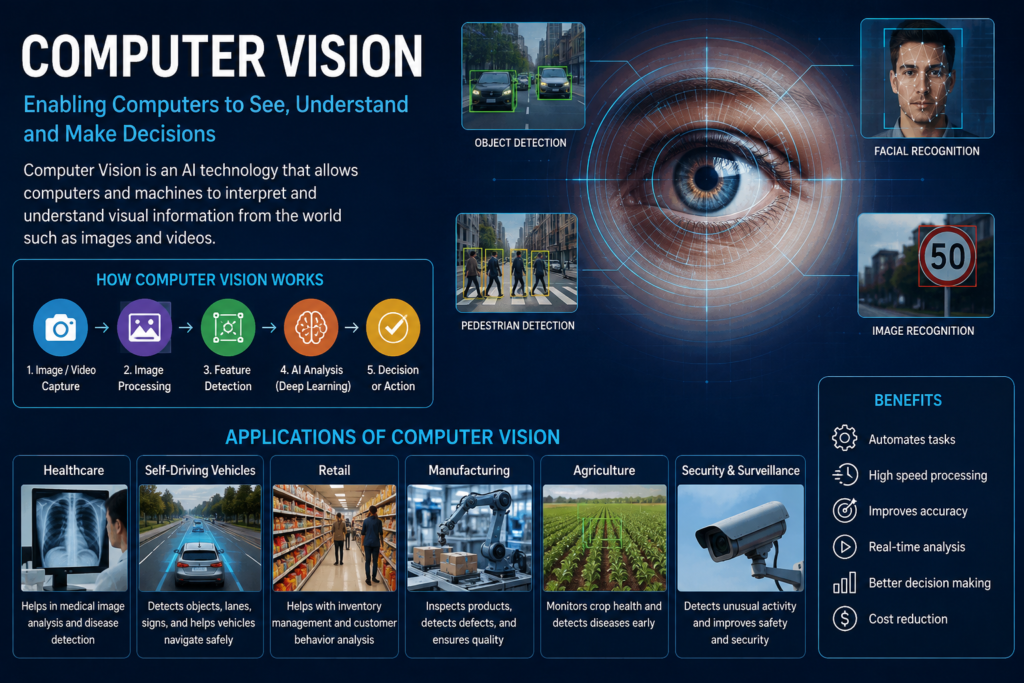
Computer Vision generally works through several steps:
- Image or Video Capture – A camera or sensor collects visual information.
- Image Processing – The system improves and prepares the visual data for analysis.
- Feature Detection – AI identifies important patterns, shapes, colors, and objects.
- AI Analysis – Machine learning or deep learning models analyze the information.
- Decision or Action – The system produces a result based on what it has identified.
Modern Computer Vision systems can process large amounts of visual information quickly and automatically.
Applications of Computer Vision
Computer Vision is used across many industries. Some common applications include:
1. Facial Recognition
Computer Vision can identify or verify people by analyzing facial features. It is used in smartphones, security systems, and identity verification.
2. Healthcare
Hospitals and medical professionals use Computer Vision to analyze medical images such as X-rays, CT scans, and MRI images. It can help identify patterns that may require further medical attention.
3. Self-Driving Vehicles
Autonomous vehicles use cameras and Computer Vision to detect roads, traffic signs, pedestrians, vehicles, and obstacles. This information helps vehicles understand their surroundings.
4. Retail
Retail businesses use Computer Vision for inventory management, customer behavior analysis, checkout automation, and product recognition.
5. Manufacturing
Factories use Computer Vision to inspect products and detect defects. Automated visual inspection can improve quality control and reduce human error.
6. Agriculture
Computer Vision can analyze crops, identify plant diseases, monitor fields, and help farmers understand crop conditions.
7. Security and Surveillance
AI-powered cameras can detect unusual activity, recognize objects, and monitor restricted areas. This can help organizations improve security and response times.
Benefits of Computer Vision
Computer Vision offers several important advantages:
- Automation: Automates repetitive visual inspection and monitoring tasks.
- Speed: Processes large amounts of visual information quickly.
- Accuracy: Can identify patterns and objects consistently when properly trained.
- Cost Reduction: Reduces the need for some manual inspection processes.
- Real-Time Analysis: Can analyze video and images as events happen.
- Better Decision-Making: Provides organizations with useful information from visual data.
Challenges of Computer Vision
Despite its advantages, Computer Vision also has challenges. Poor lighting, low-quality images, unusual objects, and complex environments can affect accuracy.
Privacy is another important concern, especially when facial recognition and surveillance systems are involved. Organizations need to use visual data responsibly and follow applicable privacy and data-protection requirements.
The Future of Computer Vision
The future of Computer Vision is closely connected to advances in AI and deep learning. More powerful models are making it possible for machines to understand complex images and videos with greater accuracy.
Computer Vision is also becoming more important in robotics, smart cities, healthcare, autonomous systems, and intelligent manufacturing.
As AI continues to develop, Computer Vision will play an increasingly important role in helping machines understand the physical world.
Conclusion
Computer Vision allows computers to understand and analyze images and videos using artificial intelligence. It is already being used in healthcare, transportation, retail, manufacturing, agriculture, and security.
With continued advances in AI, Computer Vision is expected to become even more capable and useful, creating new opportunities for businesses and improving many everyday technologies.