
Multimodal AI: How It Works, Benefits, Uses, and Future
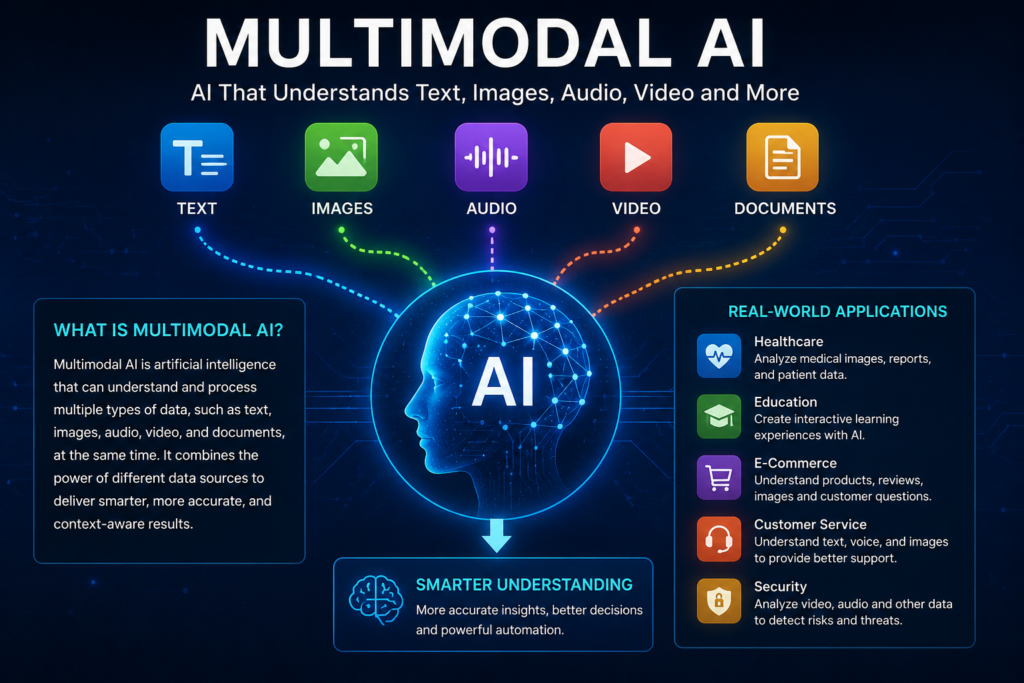
Multimodal AI is one of the most important developments in artificial intelligence. Unlike traditional AI systems that may focus on only one type of information, Multimodal AI can understand and work with different types of data, such as text, images, audio, video, and documents.
This technology is changing how people interact with AI and how businesses use artificial intelligence to solve problems, automate tasks, and make better decisions.
What Is Multimodal AI?
Multimodal AI is an artificial intelligence technology that can process and understand multiple forms of information at the same time.
For example, a Multimodal AI system can receive a picture, a written question, and a voice instruction and use all of them to produce a useful response.
Traditional AI may be designed mainly for text or images, while Multimodal AI combines different data types to provide a more complete understanding of a situation.
How Does Multimodal AI Work?
Multimodal AI uses advanced AI models to process different types of data and connect the information together.
The process usually involves:
- Data Input – The system receives text, images, audio, video, or documents.
- Data Processing – AI analyzes each type of information.
- Information Combination – The system connects information from different sources.
- Understanding – The AI identifies relationships and context between the inputs.
- Output – It produces an answer, recommendation, summary, image, code, or another useful result.
This ability to combine information makes Multimodal AI more flexible than single-purpose AI systems.
Key Features of Multimodal AI
Some of the main features of Multimodal AI include:
1. Text Understanding
It can read and understand written questions, documents, emails, reports, and other text-based information.
2. Image Understanding
Multimodal AI can analyze photographs, charts, diagrams, screenshots, and other visual information.
3. Voice and Audio Processing
It can understand spoken language and analyze audio, making AI assistants more natural and accessible.
4. Video Analysis
Multimodal AI can analyze video content and identify important events, objects, actions, or conversations.
5. Cross-Modal Understanding
One of its most powerful capabilities is connecting different types of information. For example, it can analyze an image and answer a question about what appears in that image.
Benefits of Multimodal AI
Multimodal AI offers several important benefits for individuals and businesses.
Better User Experience
Users can communicate with AI using text, voice, images, or a combination of them. This makes AI easier and more natural to use.
Improved Decision-Making
Businesses can combine information from documents, images, videos, and databases to gain deeper insights.
Increased Productivity
AI can summarize documents, analyze information, create content, and automate repetitive tasks, helping employees save time.
Better Accessibility
Voice and visual capabilities can make AI more useful for people who prefer different methods of communication.
More Accurate Context
By combining multiple data types, AI can understand a situation more completely instead of relying on a single source of information.
Applications of Multimodal AI
Multimodal AI is being used across many industries.
Healthcare
Healthcare organizations can use AI to analyze medical images, patient information, reports, and other data. This can support healthcare professionals in research and decision-making.
Education
Multimodal AI can help students understand lessons by combining text, images, voice explanations, and interactive learning materials.
Marketing
Marketing teams can use Multimodal AI to analyze advertisements, create images and videos, generate written content, and understand customer feedback.
Customer Service
AI assistants can understand written questions, voice messages, screenshots, and documents to provide more useful customer support.
E-Commerce
Online stores can use Multimodal AI to understand product images, descriptions, customer questions, and reviews.
Security
Organizations can use AI to analyze video, images, audio, and other information to identify unusual activities and potential security risks.
Software Development
Developers can use Multimodal AI to understand screenshots, explain code, analyze technical documents, and assist with software development.
Multimodal AI vs Traditional AI
Traditional AI systems often focus on a specific type of data or task. For example, one system may process text while another specializes in image recognition.
Multimodal AI brings several capabilities together.
| Feature | Traditional AI | Multimodal AI |
|---|---|---|
| Text | Yes | Yes |
| Images | Usually specialized | Yes |
| Audio | Usually specialized | Yes |
| Video | Usually specialized | Yes |
| Multiple inputs | Limited | Strong |
| Context understanding | Limited | More comprehensive |
Challenges of Multimodal AI
Although Multimodal AI has many advantages, it also has challenges.
Data requirements: Training advanced AI models can require large amounts of high-quality data.
Computing costs: Processing multiple types of information can require significant computing resources.
Privacy: Images, recordings, documents, and other data may contain sensitive information that needs to be protected.
Accuracy: AI systems can sometimes misunderstand information or produce incorrect results.
Security: Organizations need appropriate safeguards to prevent misuse of AI systems and unauthorized access to data.
The Future of Multimodal AI
The future of Multimodal AI is expected to involve more natural interactions between humans and machines.
Instead of typing a question and waiting for a text response, users may increasingly communicate with AI through a combination of voice, images, video, documents, and text.
Businesses are also likely to use Multimodal AI for customer service, automation, analytics, content creation, education, and software development.
As AI models become more capable, Multimodal AI could become a standard part of everyday applications and business systems.
Conclusion
Multimodal AI represents an important step toward more capable and natural artificial intelligence. By allowing AI to understand text, images, audio, video, and other forms of information, it can provide better context and support a wider range of tasks.
For businesses, Multimodal AI can improve productivity, customer experiences, automation, and decision-making. As the technology continues to develop, learning how to use it effectively can give organizations an important advantage in the growing AI-driven economy.